注意力的稀缺:当信息不再昂贵之后
From "the medium is the message" to the attention economy — a structural problem that keeps being treated as a personal one
A concrete question: why has abundance not made us wiser?
Over the past three decades, information has undergone an extraordinary deflation. A research report, a book, an introduction to an unfamiliar field — the cost of obtaining any of these has fallen to nearly zero. By the simplest reasoning, understanding the world should have become easier.
The experience is different. People report being more tired, less able to think for long stretches, and more likely to finish a paragraph and realise they have retained nothing.
The most popular explanation for this gap is self-control. You scroll too much; you need more willpower; you need a digital detox. The explanation is popular because it places responsibility precisely on the individual, while offering a remedy that costs almost nothing and requires no external change whatsoever.
The claim this article argues for is the opposite: the scarcity of attention is not a failure of individual will but a product of incentive structures. Treating it as a moral problem is equivalent to asking a person to swim against a current and then blaming his stamina.
To see this clearly, three things need separating: why information and attention are not the same kind of thing; why a medium is not a neutral container; and under what conditions attention gets systematically mined.
Information can be copied. Attention cannot.
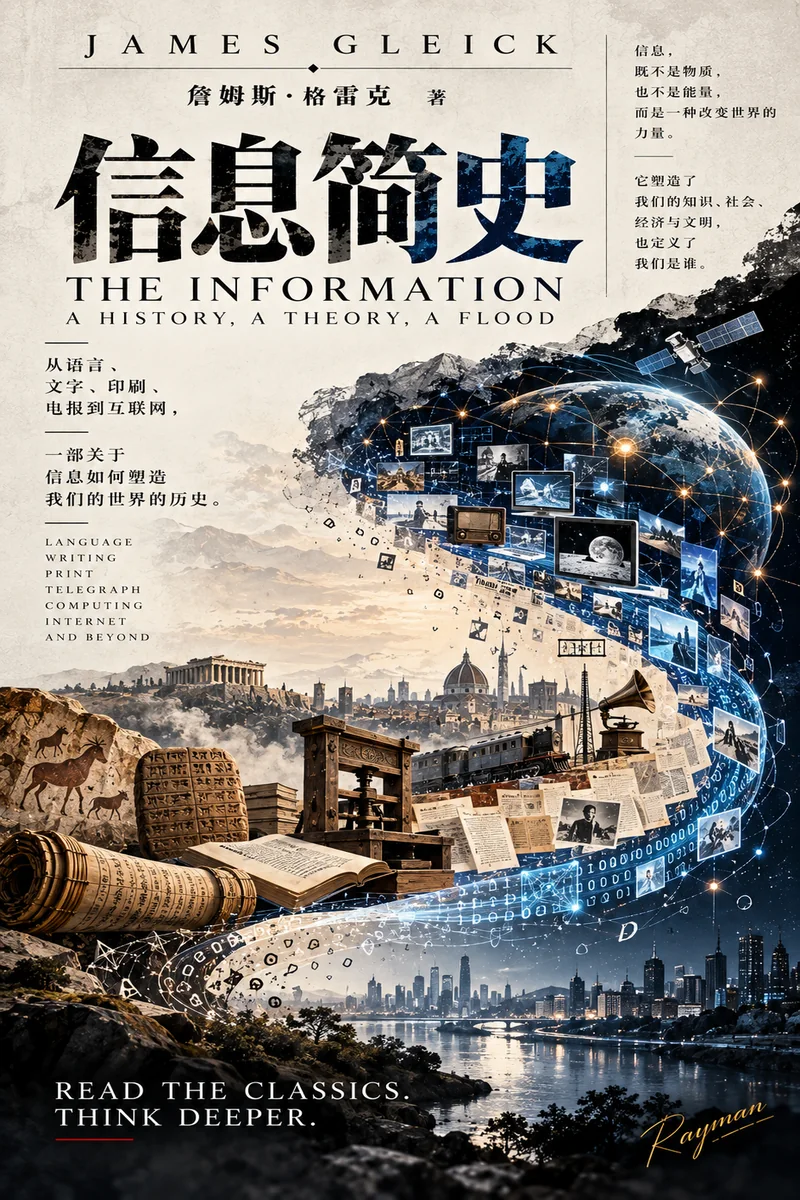
In 1948 Claude Shannon gave information a mathematical definition: how much information a message carries depends on how much uncertainty it resolves. The definition contains a deliberate blank — it says nothing about meaning. The quantity of information in a message is independent of whether the message is true or important.
That abstraction is the entire infrastructure of modern communication and storage, and it carries an easily missed consequence: information can be copied and stored without limit, at a marginal cost approaching zero. Attention cannot.
Attention has several properties that make symmetric growth impossible:
- It cannot be stored. Attention you did not spend today does not accumulate in an account for tomorrow.
- It cannot be transferred. Someone else concentrating does not understand on your behalf.
- The supply is fixed. The amount of deep attention a person can genuinely invest in a day is a small, bounded window, and it does not expand much by force of will.
- It is zero-sum. Attention spent on A is subtracted from B.
Gleick's The Information makes the first half of this clear — how information was abstracted into a measurable quantity. The second half, why attention cannot be abstracted the same way, usually goes unmentioned.
What results is a structural asymmetry: the supply side can expand without limit while the demand side is fixed. When a good has unlimited supply and fixed demand, competition does not disappear. It relocates to the demand side — and the object of competition becomes that fixed pool of attention itself.
A medium is a mould, not a container
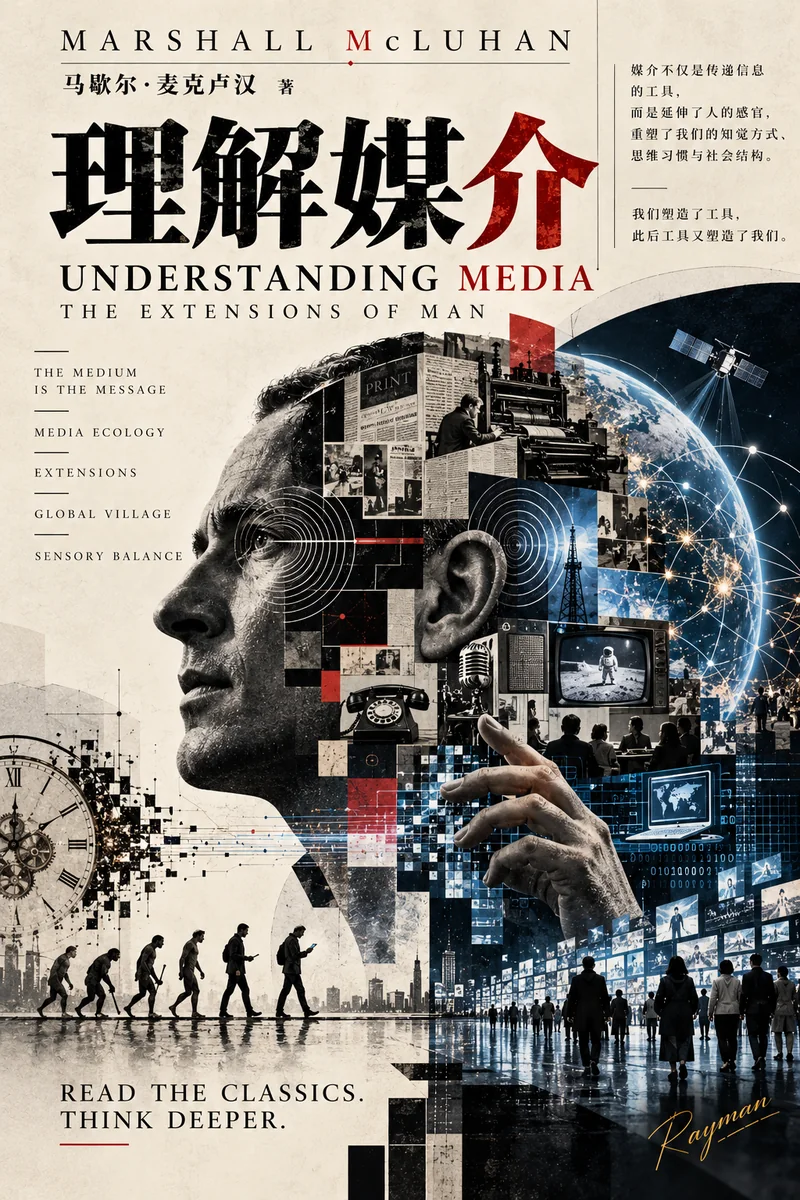
McLuhan's famous proposition in Understanding Media — the medium is the message — is usually read as a clever aside, but it is an analytical claim: the real social consequence of any medium lies not in what content it carries but in what scales, paces, and ratios of perception it rearranges.
He used the myth of Narcissus to explain the mechanism. A person extends a faculty into an external medium, and the extended faculty goes numb; the person therefore loses awareness of the change. A medium is not a neutral pipe. It reshapes the perceptual structure of its user, and the user typically cannot feel it happening.
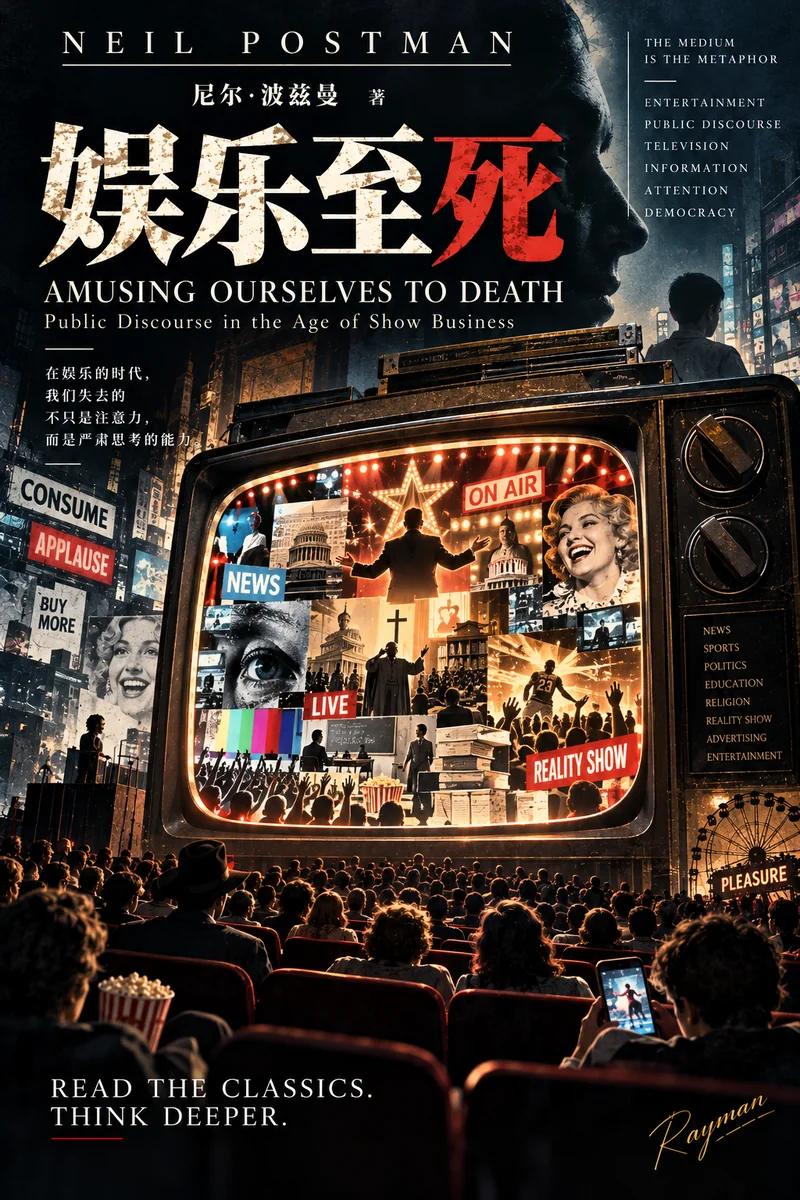
Neil Postman pushed this to the level of public discourse. In Amusing Ourselves to Death he argues that the dominant medium of an age determines what can be said seriously at all. Once entertainment becomes the main form of public speech, the problem is not whether individual programmes are vulgar; the problem is that the form itself filters out whatever cannot be turned into entertainment. His worry was that the real danger is not Orwellian information control but a Huxleyan flood of amusement that we ourselves demand.
Harari adds a further piece in Nexus. His central argument is that the primary function of an information network is to connect people and produce order, not to discover truth. Truth is expensive and depends on self-correcting mechanisms; connection and order are often achieved more efficiently through myth and fiction. So more information does not automatically produce better judgement. More often it simply makes the existing order more durable.
Put these three together and an uncomfortable inference follows: information abundance is not itself the problem. The problem is that abundance arrived inside a media environment whose objective is to capture attention.
What is being mined is not time but the capacity to be absorbed
Once attention becomes scarce, it gets priced, traded, and mined. This is not a conspiracy; it is what incentive structures do.
If a platform's revenue depends on how long users stay, then the thing it optimises is time-on-site — not comprehension, not satisfaction, not long-term wellbeing. That objective propagates downward through every layer: recommendation algorithms, interface design, notification cadence, content format. All of it converges on "thirty more seconds."
There is a structural fact here worth stating on its own. Csikszentmihalyi described the conditions of absorption in Flow: clear goals, immediate feedback, a challenge matched to skill, attention concentrated on the present. These conditions are not mystical; they can be engineered.
But the crucial point is this: the interface that addicts a person and the activity that absorbs a person are structurally near-opposites. Flow requires an endpoint, a difficulty curve, and a skill that accumulates. Infinite scroll is designed to remove the endpoint, flatten the difficulty, and prevent anything from accumulating. One produces absorption; the other produces retention. They can co-occur, and one can impersonate the other, but they are not the same thing.
Hence the most familiar experience of the day: two hours inside an app, and no account of what you did. That was not absorption. That was being held.
The counter-argument: is this just another moral panic?
There is a serious objection worth taking head-on: every new medium triggers a panic that it is destroying a generation.
The objection has history behind it. In the Phaedrus, Plato has Socrates recount an Egyptian myth in which the invention of writing will make learners stop exercising memory; they will acquire the appearance of wisdom through external marks rather than wisdom itself. Print, the novel, comics, television, video games — all have been accused of the same crime. And each time, the accusers equated a new mode of attention with a decline of attention.
Sharper still: the praise of "deep attention" often carries a class inflection. It holds up the educated, quiet, textual mode as the standard and pathologises the popular, fragmented, sensory mode. That standard is not neutral.
All of this is fair. But it misses one genuinely new variable: the feedback loop.
Earlier media were one-way and mass-produced. The printing press did not know who was reading which page; a television station did not know which shot made you change the channel. So although such media shaped perception, the shaping was coarse, addressed to groups, and delayed. Today's media are different: they measure each person's behaviour in real time and feed the measurement straight back into the design of the next stimulus.
The line between quantitative and qualitative change is not the volume of information but whether stimulation can be adjusted per person, in real time. The moral-panic argument explains why we should not be alarmed by a new medium as such. It does not explain why, this time, the objective has been written as a number that can be maximised precisely — time on site.
The judgement: attention is an infrastructure problem, not a moral one
So what follows? First, rule out a mistaken framing: "reclaiming your attention" is a flawed formulation.
Attention is not property that can be locked in a safe. It is a relation — a state sustained jointly by environment, bodily condition, and task structure. You cannot "own" attention in a vacuum any more than you can "own" stamina in a vacuum. Which is why every programme built on individual willpower and self-training runs into the same wall: it is working against the environment.
This does not leave the individual with nothing to do. It means individual action should be structural rather than volitional:
- Change defaults instead of adding willpower. Set devices to require active retrieval rather than push; move the entry point further away rather than resolving not to tap it. Defaults make decisions on your behalf, and they are far more reliable than resolve.
- Give attention an endpoint. Among the conditions of flow, the most neglected is that goals be clear and finite. Only an activity with an endpoint lets skill accumulate, and skill is the only real source of the feeling of absorption.
- Separate retention from absorption. A workable self-test: if you cannot say what you gained once it is over, it belonged to the first category.
At the structural level, the real variable is not the medium but incentives and ownership. The same technology produces entirely different outcomes under different business models. Making time-on-site the single optimised metric is a commercial choice, not a technological necessity. Treating it as technological fate means abandoning the most effective layer of intervention available.
So the judgement reduces to one sentence: attention is scarce not because people have grown weaker but because the environment has been designed to consume it. Asking individuals to hold the line through self-discipline, against a system optimised precisely for that contest, is a structural problem wearing the costume of a moral one — and moral problems always sound easier, because the only thing that seems to need changing is you.