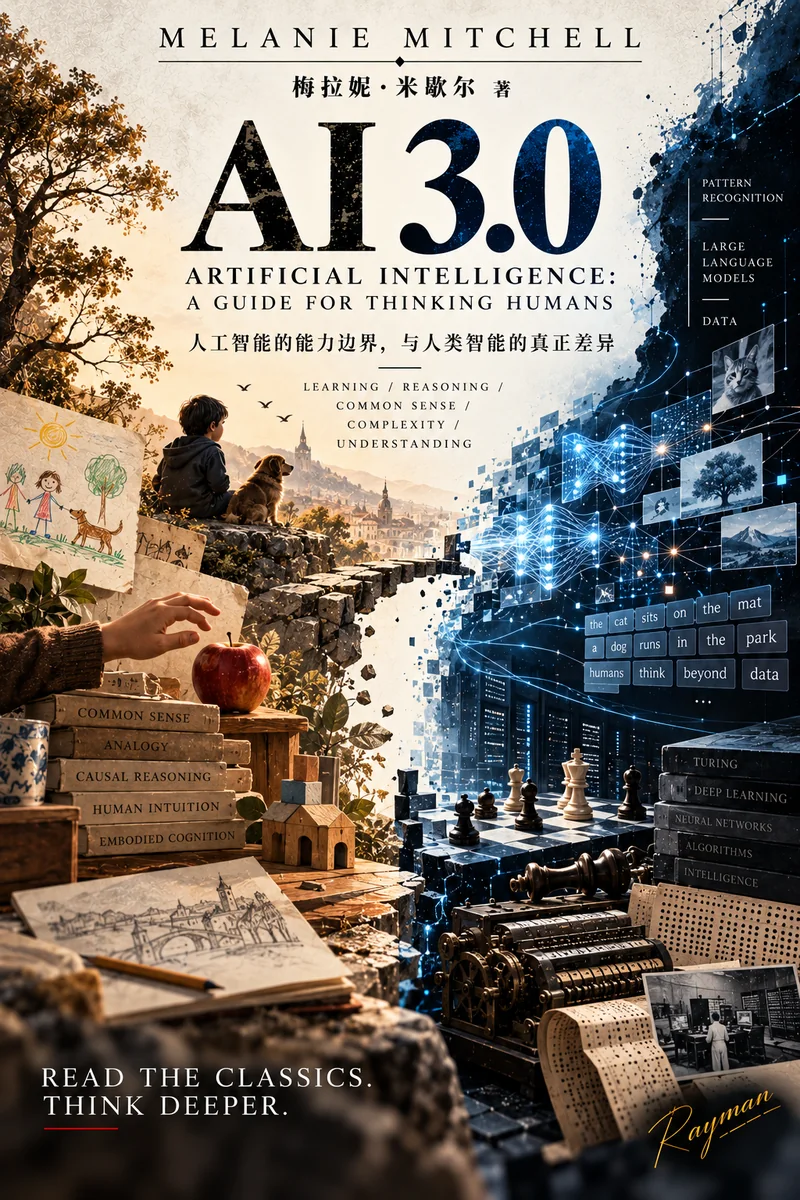
Artificial Intelligence 2019 Daily Pick
Artificial Intelligence
《AI 3.0》
- Published
- 2019
- Category
- Artificial Intelligence
- Original language
- en
- Source list
- Daily Pick
What AI can and cannot do: a cognitive scientist's sober inventory of the limits of artificial intelligence
Imported from a third-party reading list or added as a daily pick — bibliographic facts, the source framing, and a full reading guide.
Source theme
What AI can and cannot do: a cognitive scientist's sober inventory of the limits of artificial intelligence
What is this book about?
AI 3.0 is a 2019 book by the American computer scientist Melanie Mitchell, a professor at the Santa Fe Institute. It neither forecasts a singularity nor trades in alarm; it treats the question of what artificial intelligence can actually do today as an empirical matter to be checked item by item. The book has five parts: it opens with the history and basic concepts of AI, then examines how machines see, how they play (taking games such as Go as its case study), and how they handle natural language, before converging on a central difficulty — the barrier of meaning: machines can achieve astonishing performance on vast data yet struggle to acquire a genuine understanding of the world. Mitchell affirms the real breakthroughs brought by deep learning while systematically identifying its fragilities: dependence on the data distribution, the absence of common sense, and collapse under slight perturbations. She repeatedly distinguishes capability in a demonstration from robustness in the real world, pulling the excited narrative back to testable evidence.
Why read it?
In an age torn between the claim that general intelligence is imminent and the claim that AI is mere statistical trickery, this book offers a third position: it grants that the progress is real and insists that the limits are hard. Mitchell is one of the few authors with both engineering intuition and a cognitive-science perspective; she can explain the inner workings of deep learning and also explain why seeming to talk is not the same as actually understanding. For anyone doing technology selection, investment judgement, or product planning, this discipline of distinguishing demonstration from capability, and benchmark scores from real-world robustness, is precisely the scarcest judgement of the moment. It also reconnects AI with cognitive science — understanding how machines fail is often the shortest route to understanding what makes human intelligence distinctive.
Core Ideas
- Intelligence is a patchwork, not a single dimension: AI's progress is wildly uneven across tasks, surpassing humans in some domains while remaining infantile in others; general intelligence is nowhere near achieved.
- The power and the limits of deep learning: it breaks through by means of vast data and statistical correlation, but it lacks causal models and common sense and tends to fail outside its training distribution.
- Understanding is not pattern matching: fluent output may be a clever rearrangement of training data; genuine understanding requires concepts, reference, and causation — which is exactly the barrier of meaning.
- Analogy is central to intelligence: human intelligence depends on abstracting relations from particulars and transferring them to new situations, and machines remain weak at this step.
- Beware demonstrations and hype: a dazzling demo or a handsome benchmark score is not the same as reliable capability; closed tasks must be distinguished from the open world.
- The human-machine difference is structural: in perception, common-sense reasoning, and language understanding, the gap between current AI and human intelligence is not one of degree but of mechanism.
What questions does this book try to answer?
- Where exactly does the fundamental difference between artificial and human intelligence lie?
- To what extent is deep learning understanding, and to what extent is it only pattern matching?
- What is still missing from the current path toward general intelligence?
Who should read it?
Suited to AI practitioners, technology managers, and investors as a calibrator against hype; also to readers in cognitive science, psychology, and philosophy who want to understand the similarities and differences between artificial and human minds. Basic computer or scientific literacy is enough — no background in mathematics or programming is required.
How to Read It
The five parts build on one another and are best read in order. If time is short, read the parts on seeing and on playing first to build a concrete intuition for how strong and how brittle AI performance is; then give priority to the part on natural language and the barrier of meaning, where the book's argument comes to rest. Treat each case as a stress test: what the author displays is often not the capability but its boundary. Read it alongside Gödel, Escher, Bach for analogy and meaning, and alongside The Alignment Problem for different concerns about the same technological reality. The Chinese edition is AI 3.0, published by Sichuan Science and Technology Press.