Psychology & Cognitive Science 1991 Daily Pick
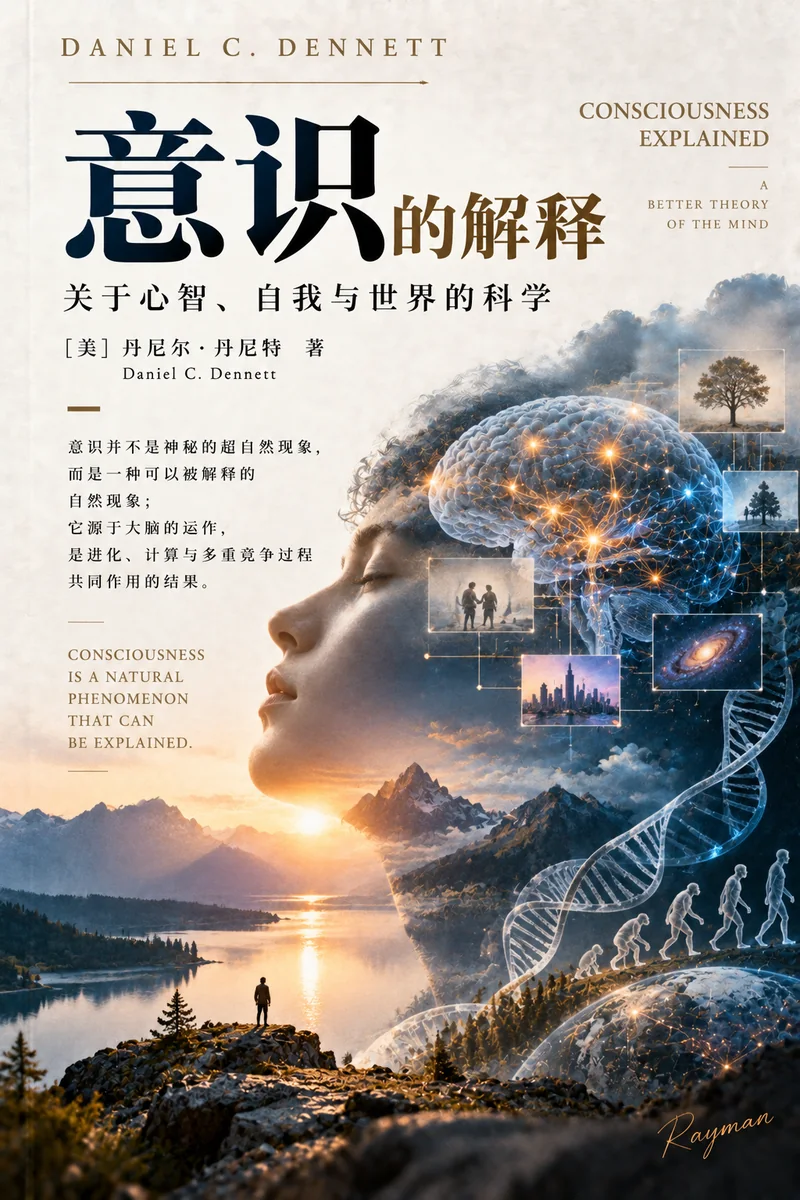
Consciousness Explained
《意识的解释》
- Published
- 1991
- Category
- Psychology & Cognitive Science
- Original language
- en
- Source list
- Daily Pick
Consciousness is not a screen or a center in the brain but what emerges when many parallel processes compete for 'fame'
Imported from a third-party reading list or added as a daily pick — bibliographic facts, the source framing, and a full reading guide.
Source theme
Consciousness is not a screen or a center in the brain but what emerges when many parallel processes compete for 'fame'
What is this book about?
Consciousness Explained is the philosopher Daniel C. Dennett's 1991 book and, by his own account, his most important. Its aim is a theory of consciousness compatible with neuroscience and free of mysterious entities. Dennett first dismantles what he calls the Cartesian theater — the picture of a central stage in the brain where conscious contents are displayed before being viewed by an inner 'I'. In its place he offers the multiple drafts model: many processes running in parallel continually revise one another, and what we call a conscious content is not a finished text at any moment but the outcome of those processes competing for 'fame in the brain'. He also proposes heterophenomenology, which takes subjects' reports seriously and neutrally as data from which testable models can be built. The later sections argue that human consciousness is substantially shaped by language and culture and progressively 'installed' through social interaction.
Why read it?
Anyone concerned with artificial intelligence and mind has to reckon with this book. It takes an extreme but highly productive position: consciousness is not a mysterious addition requiring its own special explanation, but a phenomenon emerging from many parallel, competing, mutually revising processes. Dennett's demolition of the Cartesian theater challenges the intuition that the self sits somewhere in the brain, and shows why treating consciousness as a center leads AI architecture astray. His handling of the Turing test, zombie arguments, and qualia remains a standard reference in the debate.
Core Ideas
- The Cartesian theater is a mistake: there is no central stage in the brain where conscious contents are first displayed in full and then viewed by an inner spectator.
- The multiple drafts model: many processes of editing and re-editing occur in parallel, and conscious content is the upshot of those processes competing for 'fame in the brain'.
- Heterophenomenology: in studying consciousness we should first take subjects' reports neutrally as material to be explained, not as reliable reports about inner mechanisms.
- Qualia conceived as private, ineffable, immediately given properties do not survive scrutiny and should be re-described or abandoned.
- Human consciousness is not a purely biological given; it is progressively constructed and 'installed' through language, culture, and social interaction.
What questions does this book try to answer?
- If there is no central stage in the brain, why do we have the sense of a unified, private, present experience?
- How can subjective experience be brought into an objective science without being reduced to untestable introspective reports?
- For an artificial intelligence to be conscious, is what is missing computing power, or a structure constructed through culture and language?
Who should read it?
Readers interested in the philosophy of mind, cognitive neuroscience, and artificial intelligence. AI researchers will take away an architectural warning that consciousness is not centralized; philosophy readers will see how analytic philosophy handles evidence from the empirical sciences; general readers with patience can follow it and re-examine the intuition of a self. It demands tolerance for abstraction but no specialist background.
How to Read It
The book is long and argument-dense, so do not force your way through from page one. Start with the introduction and Part I on dismantling the Cartesian theater, then Part II on the multiple drafts model, and only then the later sections on qualia and on consciousness as a cultural construction. Reading it beside Descartes' Error is rewarding: Damásio questions the mind–body split from neuroscience while Dennett dismantles the inner theater from philosophy, and the intuition they attack is the same one.