Artificial Intelligence 1969 Daily Pick
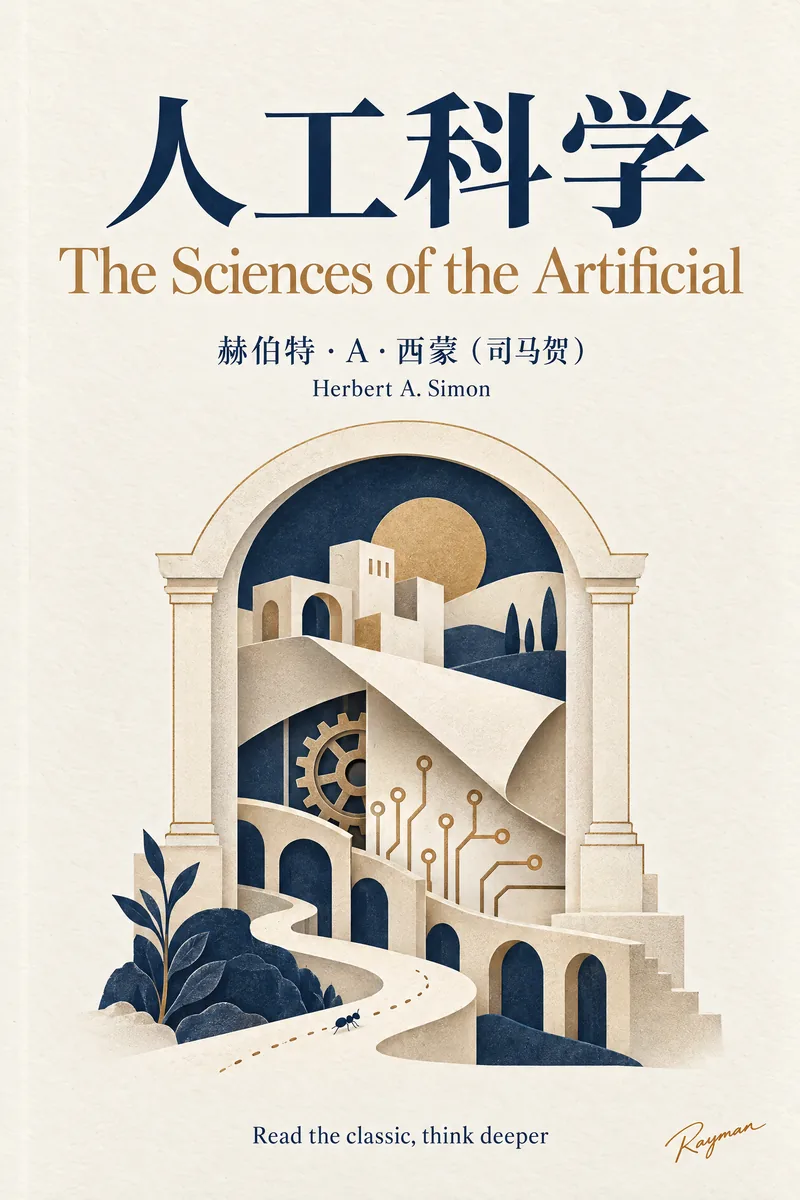
The Sciences of the Artificial
《人工科学》
- Published
- 1969
- Category
- Artificial Intelligence
- Original language
- en
- Source list
- Daily Pick
A science of the artificial: design, hierarchy, and intelligence as search
Imported from a third-party reading list or added as a daily pick — bibliographic facts, the source framing, and a full reading guide.
Source theme
A science of the artificial: design, hierarchy, and intelligence as search
What is this book about?
The Sciences of the Artificial (1969) is Herbert A. Simon's systematic study of the world of artificial things. Simon uses artificial for everything designed and made by humans — programs, organizations, buildings, machines — and argues that such objects are not copies of nature but functioning systems adapted to their environments, requiring a science of design distinct from the natural sciences. Starting from the apparent complexity of an ant's path on a beach, the book moves through hierarchical structure, search and heuristics, economic rationality and the psychology of thinking, and ends with the physical symbol system hypothesis: a physical symbol system has the necessary and sufficient means for intelligent action.
Why read it?
One of the founding texts of artificial intelligence, it shaped the research agenda of AI, cognitive science and design studies for decades. Two of its judgments remain directly useful: apparent complexity often comes from the environment rather than the system's internals, and complex systems must be understood through their hierarchies and adaptive processes. For those building large models, agents and organizations it offers a problem frame rather than an obsolete conclusion.
Core Ideas
- The world of artifacts calls for a science of design: it asks how objects adapt to goals and environments, not only how they obey natural laws.
- Apparent complexity comes from the environment: the ant's winding path reflects the complexity of the terrain, not necessarily a complex interior.
- Hierarchy is the architecture of complexity: nearly all complex systems are hierarchically organized, and nearly decomposable ones are the ones we can understand.
- Problem solving is search: chess, theorem proving and decision making are heuristic search through a vast space of possibilities.
- The physical symbol system hypothesis: a physical symbol system has the necessary and sufficient means for intelligent action.
What questions does this book try to answer?
- How is a science of the artificial possible — what are its objects, methods and criteria of evaluation?
- How should we understand complex systems: is complexity a property of the system, or of the system's interaction with its environment and observer?
- What structure and processes must a machine have in order to exhibit intelligent action?
Who should read it?
Written for computer and AI practitioners, students of cognitive science, systems designers and managers. Its treatment of complexity, hierarchy and heuristics repays rereading, and it pairs well with Cybernetics and Melanie Mitchell's Artificial Intelligence.
How to Read It
Seven chapters plus appendices: short but dense. Start with chapter 1 and the 'Architecture of Complexity' chapter, then move to the analysis of the ant and hierarchy, and finish with the physical symbol system argument. The Chinese edition, titled 人工科学 with the subtitle 复杂性面面观, was published by Shanghai Scientific and Technological Education Publishing House in 2004.