分工的账本:当能力从人身上搬到系统里
From the pin factory to the smart factory — why efficiency, capability, and risk are never booked on the same page
1. Output rose by two orders of magnitude, and nobody worked harder
Adam Smith opens The Wealth of Nations with a pin factory. Making a pin takes about eighteen distinct operations. A workman not trained to the business, unfamiliar with the machinery it now uses, could scarce make one pin a day, and certainly not twenty. Ten men, dividing the work, could make upwards of forty-eight thousand pins in a day — four thousand eight hundred each.
What makes the number striking is not its size but how it was obtained. Same people, same trade, before any new machine appears: simply splitting the work multiplies output by roughly two orders of magnitude. Smith gives three sources of the gain — increased dexterity, the time saved in not switching tasks, and the greater likelihood that someone will invent a machine to do a step. The third is the interesting one: the machine is not the precondition for the division of labour but its product. A man who spends his life on one operation is the man who notices which tool could replace it.
But the same book carries an equally important sentence: the division of labour is limited by the extent of the market. A step narrow enough to be worth splitting off must have a market large enough to absorb what it produces. The gains from splitting are never free; they presuppose demand wide enough to pay for them. That sentence stings far more now than it did in 1776.
2. Capability relocates: the system grows stronger, the person grows narrower
The real consequence of division of labour is not that output rises. It is that capability changes address.
Before the split, capability lives in people: the craftsperson knows the material, the sequence, and where things go wrong. After the split, capability has moved into the process, the standards, and the coordination layer — quality now depends on the design of the seams rather than on any individual's skill. This is not a loss but a precise exchange. Donella Meadows's point in Thinking in Systems applies directly: system behaviour is governed by structure, and the quality of the parts explains only a small fraction of it.
The exchange has a price. In Book V Smith writes that when a man's whole life is spent on a few simple operations he has no occasion to exert his understanding, loses the habit of doing so, and "generally becomes as stupid and ignorant as it is possible for a human creature to become." The remedy Smith then proposes is not a return to handicraft but public education — because in a civilized society this is the condition into which the great body of the people must fall, unless deliberate effort prevents it.
That second half is rarely quoted today. It shows that Smith treated division of labour as a ledger in 1776: output on the credit side of society, capability on the credit side of the person, and no automatic transfer between the two columns.
3. The strongest objection: division is the only way knowledge outlives a lifetime
The strongest case against this line of criticism is not that the costs are small. It is that splitting does not merely fragment what already exists — it creates capability no single brain could hold.
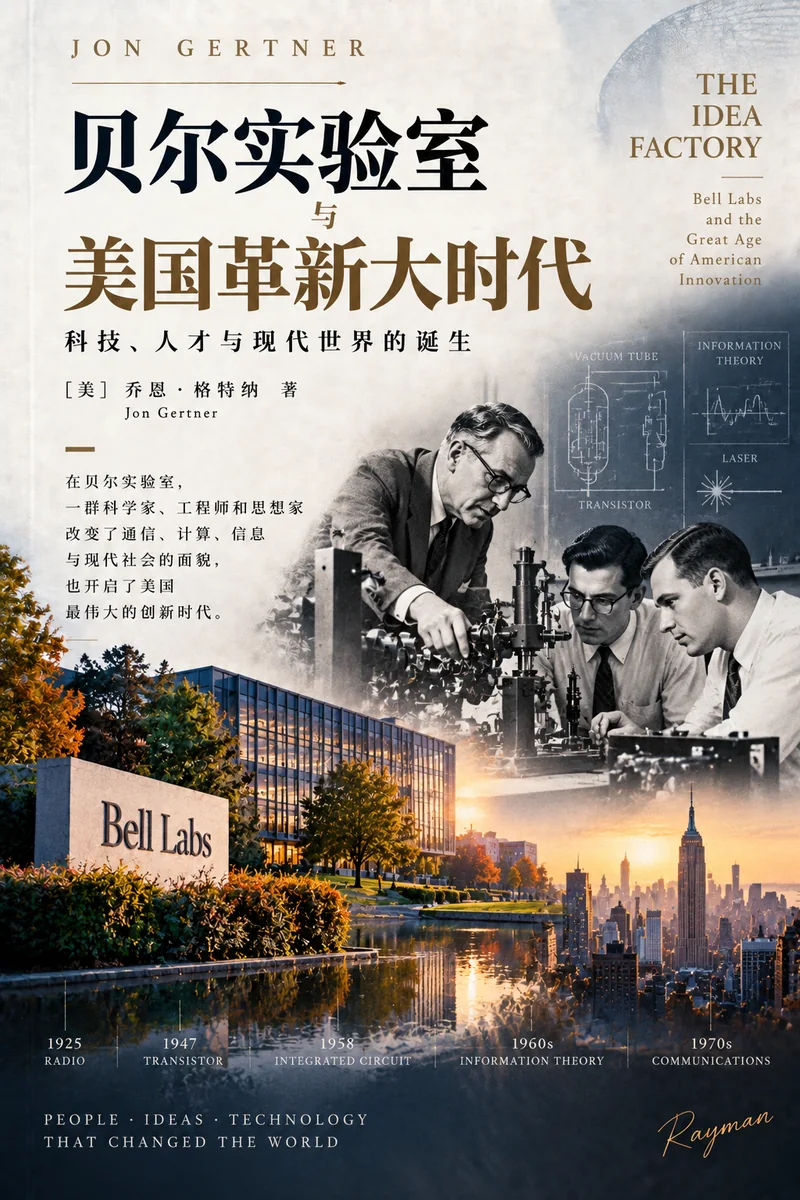
Bell Labs is the cleanest evidence. In The Idea Factory, the transistor is not a moment of inspiration but a chain of problems resolved in sequence: material purity, the purification of germanium and silicon, crystal growth, device design, and system application. Each link demanded depth in one field, and no all-round genius could cross all of them. Mervin Kelly's design — different disciplines placed along the same corridor, decades of stable funding for work with no short-term use — is an extension of the same division of labour. It splits too; it just designs the seams so that connections form there.
So the fault is not in the splitting. Division of labour is the only mechanism by which accumulated knowledge can exceed a single lifetime. Nobody rebuilds a transistor alone, just as nobody builds an aircraft alone. Hand the work back to the all-round craftsperson and what you get is scarce, expensive, and uneven in quality.
Scott Hartley's The Fuzzy and the Techie supplies the mirror image: the product failures he records are usually not technical shortfalls but teams in which nobody was responsible for understanding the user. The engineering chain was cut finely; the piece that should have understood people was simply missing. That is also a failure of splitting — the cut was wrong.
4. The second split: machines take the cognitive fragments
The split has now moved inside cognitive work.
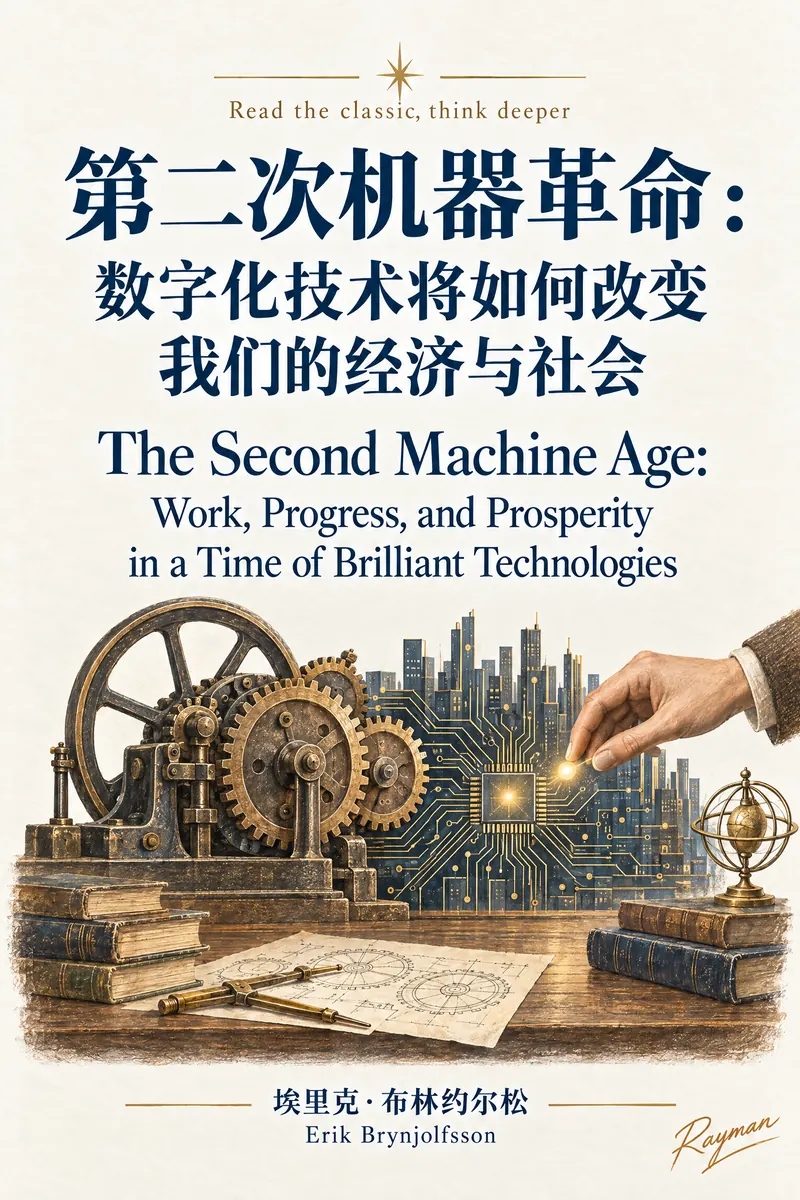
Brynjolfsson and McAfee's claim in The Second Machine Age is that digital technology lets machines substitute for cognitive labour at scale for the first time, not merely physical labour. What used to be split was fastening, drawing wire, inspecting. What is split now is reading, drafting, checking, summarising, reporting. The white-collar "whole task" has for the first time become a divisible assembly line.
The value of the book is that it keeps two ledgers separate: the aggregate one looks excellent (productivity up), the distribution one looks bad (median income stalls). Neither ledger records a third: what is left of the person who was cut.
NHK's documentary team filed that slice in Sanshi Buri — roughly, "not yet standing at thirty." The reporters followed the generation that entered the Japanese labour market after the bubble burst: short contracts, low pay, thin security, still unable to stand on their own in their thirties. This is not a story of individual insufficient effort. When employment institutions slice work into thin layers, people cannot accumulate experience, and cannot see the result of their own work in one place. The book should be read as a time slice — it appeared around 2010 and its authors note that the figures and institutions have since moved — but the mechanism is not tied to one country.
What all of these cases are missing is the same thing: a closed loop. The person who makes a pin sees the pin. The engineer who writes a module does not see the user. The manager who sets the target does not see the decision. The evidence from Tetlock's Superforecasting shows why that matters: only those who can score their own judgements quickly and see the results can improve through small, frequent updates. Where the feedback loop is cut, learning stops.
5. Judgment: book it on one page
The conclusion compresses into three sentences.
- The gains are real, and nostalgia for craft is not an answer. Scarce, expensive perfection is not progress.
- What needs auditing is not task completion but loop closure: can the person see the outcome of their own work? Where they cannot, someone should be responsible for restoring that visibility — rather than treating people as components that require none.
- Organisations should maintain the capability of reassembling the fragments as an asset: people who think across functions, who can translate between trades, who will carry the burden of judgement. The lesson of The Idea Factory is that such redundancy is the first thing to be cut, precisely when the system appears to need it least.
The limit must be stated plainly: where the whole is too large for any individual to hold — chip fabrication, civil aviation, power grids — splitting is not the cost but the only option. The feasible goal is not to un-split but to make the interfaces legible and traceable, so that each fragment can see a stretch of what lies upstream and downstream. That is an engineering problem, but also a governance one: who is accountable for the people who never see the consequences?
One-line version: division of labour moved capability out of people and into systems; output is booked to society's account, while human capability and risk are booked to an account with no manager.