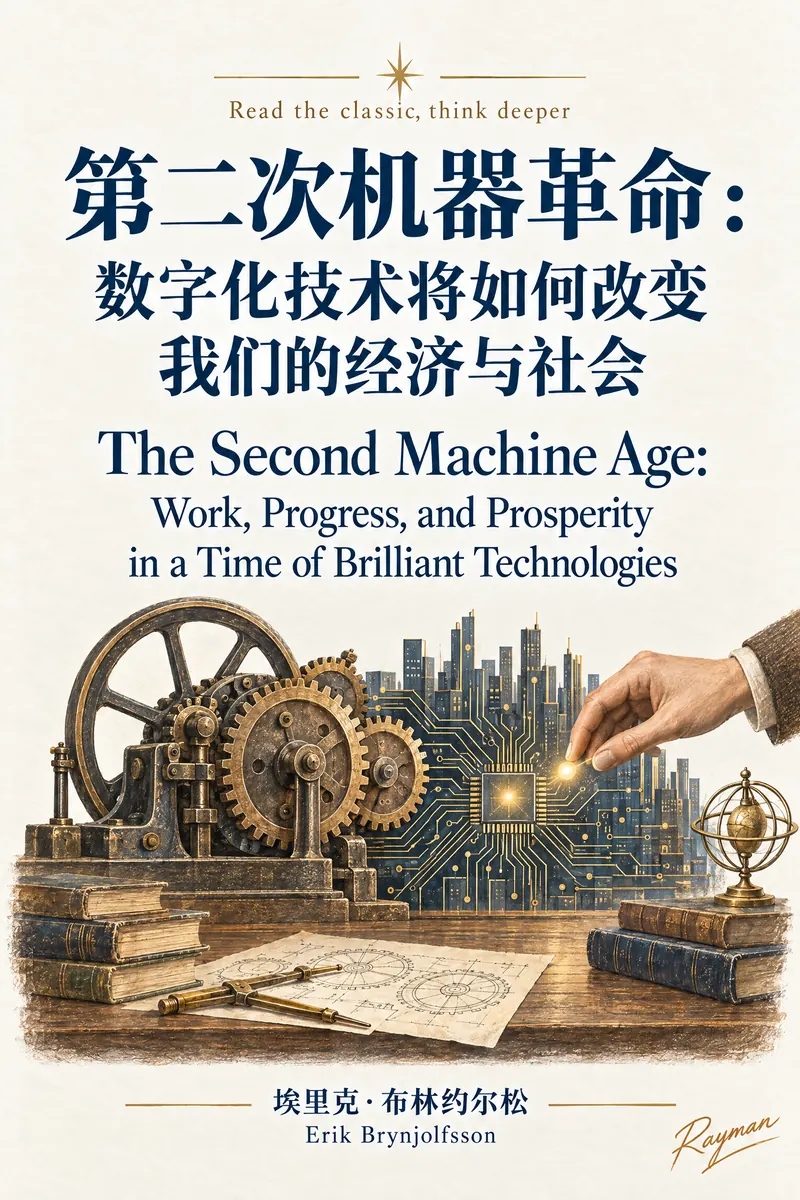
Technology & Science 2014
The Second Machine Age
《第二次机器革命》
Work, Progress, and Prosperity in a Time of Brilliant Technologies
- Published
- 2014
- Category
- Technology & Science
- Difficulty
- Intermediate
- Reading time
- ~12 hours
- Original language
- en
The Classic Index is not an objective scientific measure. It is this site's personal curation score.
What is this book about?
Brynjolfsson and McAfee argue that digital technology now lets machines substitute for cognitive as well as physical labor, opening a “second machine age.” They offer both an optimistic growth story and a warning about distribution: productivity can rise while median income stalls.
Why read it?
It separates two questions that are often conflated — whether technology advances and who benefits from it — and supplies a framework for discussing automation and employment. Even where predictions are doubtful, looking at both aggregate and distribution at once remains essential.
Core Ideas
- Digital technology lets machines substitute for cognitive labor at scale for the first time, not just physical labor.
- Progress enlarges the total, but gains may concentrate sharply, detaching the median from the average.
- Standard growth measures miss the value of free digital goods, so the statistics understate real welfare.
- Education, entrepreneurship, and institutional adjustment are the key levers for sharing the gains.
What questions does this book try to answer?
- When machines displace cognitive as well as physical labor, how do growth and employment diverge?
- How should the gains from technology be distributed to prevent median stagnation?
Who should read it?
For readers concerned with economics, employment, and technology policy. Basic economics helps; no technical background is required.
Related Books
If you like this book