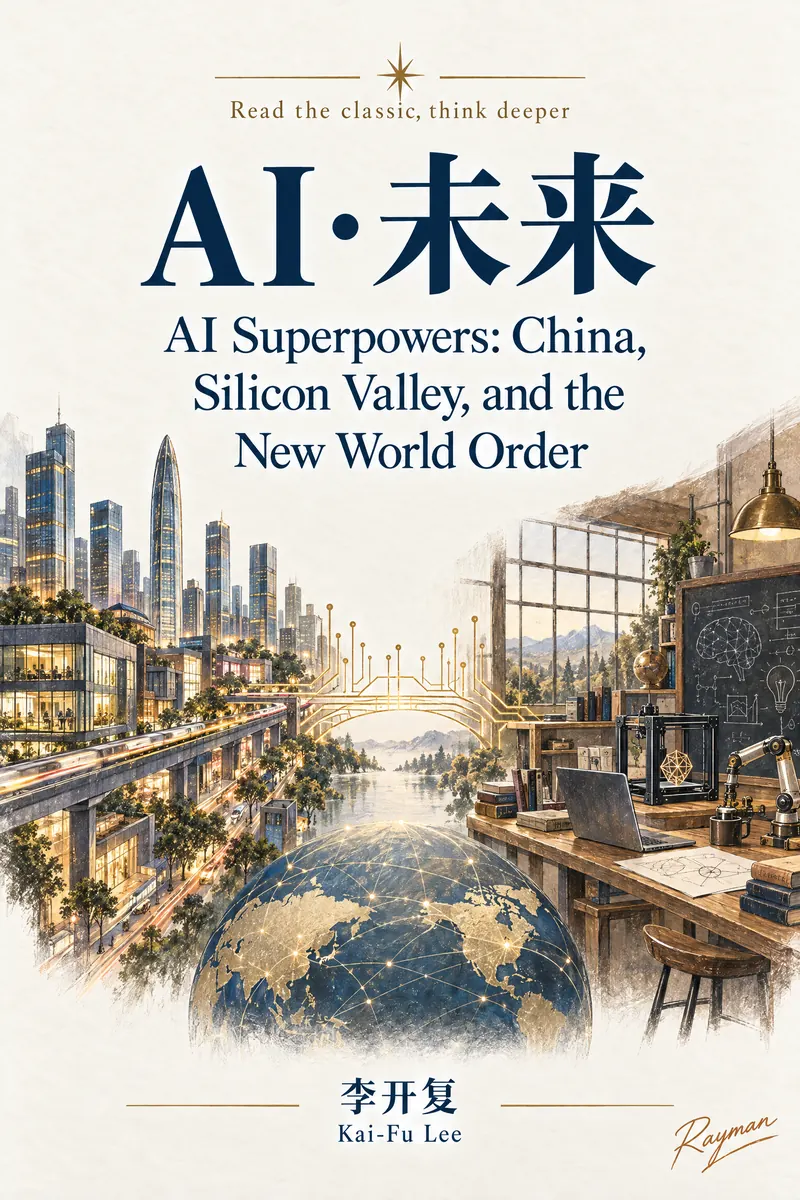
AI Superpowers
《AI·未来》
China, Silicon Valley, and the New World Order
- Published
- 2018
- Category
- Artificial Intelligence
- Difficulty
- Intermediate
- Reading time
- ~12 hours
- Original language
- en
The Classic Index is not an objective scientific measure. It is this site's personal curation score.
What is this book about?
Lee contrasts two Chinas — one of ubiquitous mobile payment and data scale, one of Silicon Valley's research tradition. He argues that China's edge in applications comes from brutal market competition and engineering supply rather than any single breakthrough, and reasons from there about how automation will hit white- and blue-collar work.
Why read it?
It offers a testable framework: technological advantage comes from the structure of data, markets, and talent, not national character. Several concrete predictions have dated, but the distinction between strength in applications and strength in basic research still travels well.
Core Ideas
- China's edge in AI applications comes from data scale, engineering supply, and fierce domestic competition, not from basic research.
- The gains and costs of progress are unevenly distributed; automation hits manual work and parts of cognitive work at once.
- Competition among AI superpowers reshapes global supply chains and technical standards, not merely the fortunes of firms.
- Facing automation, society needs more than retraining: it needs to rethink the meaning of work and the rules of distribution.
What questions does this book try to answer?
- What exactly are the US and China competing over in AI?
- When automation displaces large numbers of jobs, how should society redistribute both gains and meaning?
Who should read it?
For readers following the tech industry and US-China competition. It is valuable as first-hand industry observation, but should be read against more recent data.
Related Books
If you like this book