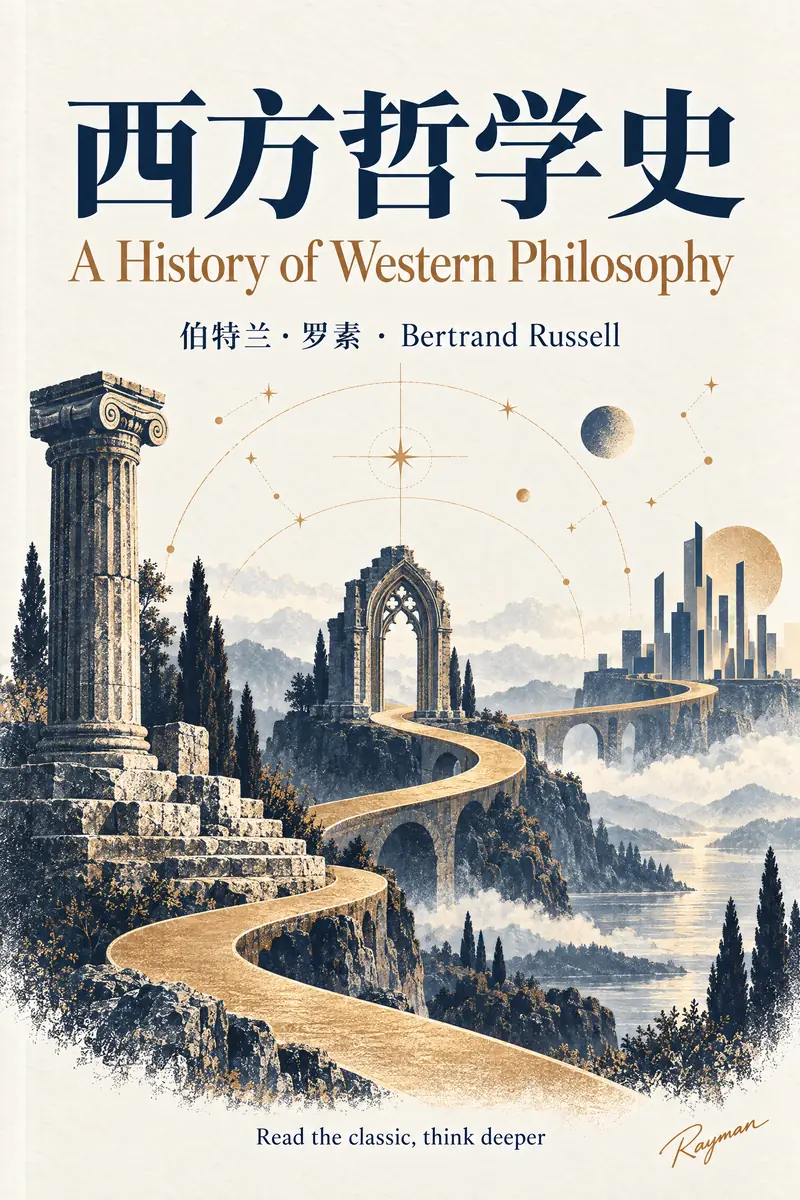
Philosophy 1945 Daily Pick
A History of Western Philosophy
《西方哲学史》
- Published
- 1945
- Category
- Philosophy
- Original language
- en
- Source list
- Daily Pick
Two and a half millennia of Western philosophy told inside its social and political context
Imported from a third-party reading list or added as a daily pick — bibliographic facts, the source framing, and a full reading guide.
Source theme
Two and a half millennia of Western philosophy told inside its social and political context
What is this book about?
Written for general readers, this is Russell's narrative of Western philosophy from the pre-Socratics to the analytic work of his own contemporaries. It is organised in three books: ancient philosophy from Thales through Aristotle, Catholic philosophy from Augustine through Aquinas and the medieval scholastics, and modern philosophy from the Renaissance to the early twentieth century. What sets it apart is method. Russell treats every philosopher as a figure embedded in a concrete social and political situation, arguing that doctrines both reflect their times and act back upon them; the full subtitle is precisely a claim about this connection. The book began as a set of lectures delivered in the United States in 1941, and the result is a history of ideas that is also a history of the West.
Why read it?
It is the most widely read history of philosophy written in the twentieth century and forms part of the case for Russell's 1950 Nobel Prize in Literature. Its strength and its controversy are the same thing: Russell, himself a first-rank philosopher, selects, ranks and verdicts, writing with clarity and open preference rather than textbook neutrality. For Chinese readers the Commercial Press translation sits in the distinguished series of translated world classics, making it the most economical single volume for building a coordinate system of Western thought. It is an entry point rather than an endpoint; its treatment of Aristotle and Hegel is famously harsh and should be treated as one philosopher's position.
Core Ideas
- Philosophy is a continuum rather than a set of isolated propositions. Every epoch's thinking is entangled with its politics, religion and science: Plato is unintelligible without the decline of the polis, Locke without the English Revolution.
- Philosophers are at once products of and agents upon their social environment. Doctrines are shaped by material conditions and in turn supply the vocabulary that legitimises later institutions; both directions operate at once.
- The boundary of philosophy moves with the centuries. Medieval philosophy is inseparable from theology and early modern philosophy from natural science; Russell presents philosophy as repeatedly separating from and flowing back into its parent bodies.
- Writing a general history is itself a philosophical act. Inclusion, exclusion and ordering all express substantive commitments, and the reader should learn to separate Russell's narrative from his verdicts.
What questions does this book try to answer?
- To what extent is a philosophical doctrine the product of its social and political circumstances, and to what extent does it carry validity that exceeds its own time?
- From Thales to analytic philosophy, is there one identifiable continuous chain of problems in Western thought, or merely several broken traditions laid side by side?
Who should read it?
Anyone who wants the shortest path to a coordinate system for Western intellectual history; readers curious about philosophy but deterred by the technicality of academic histories; and those who want context before tackling primary texts. It also suits readers already rooted in one tradition, whether analytic or continental, who want the wider map. No prerequisites are needed, only tolerance for an author who renders verdicts.
How to Read It
Read the three books in order rather than skipping. Short on time, prioritise Book I on ancient philosophy and the opening and closing of Book III on modern philosophy, moving quickly through the medieval book. Learn to separate Russell's narrative from his evaluations: the former is history, the latter one philosopher's position. Readers who want the standard against which he judges can pair it with his own Problems of Philosophy.