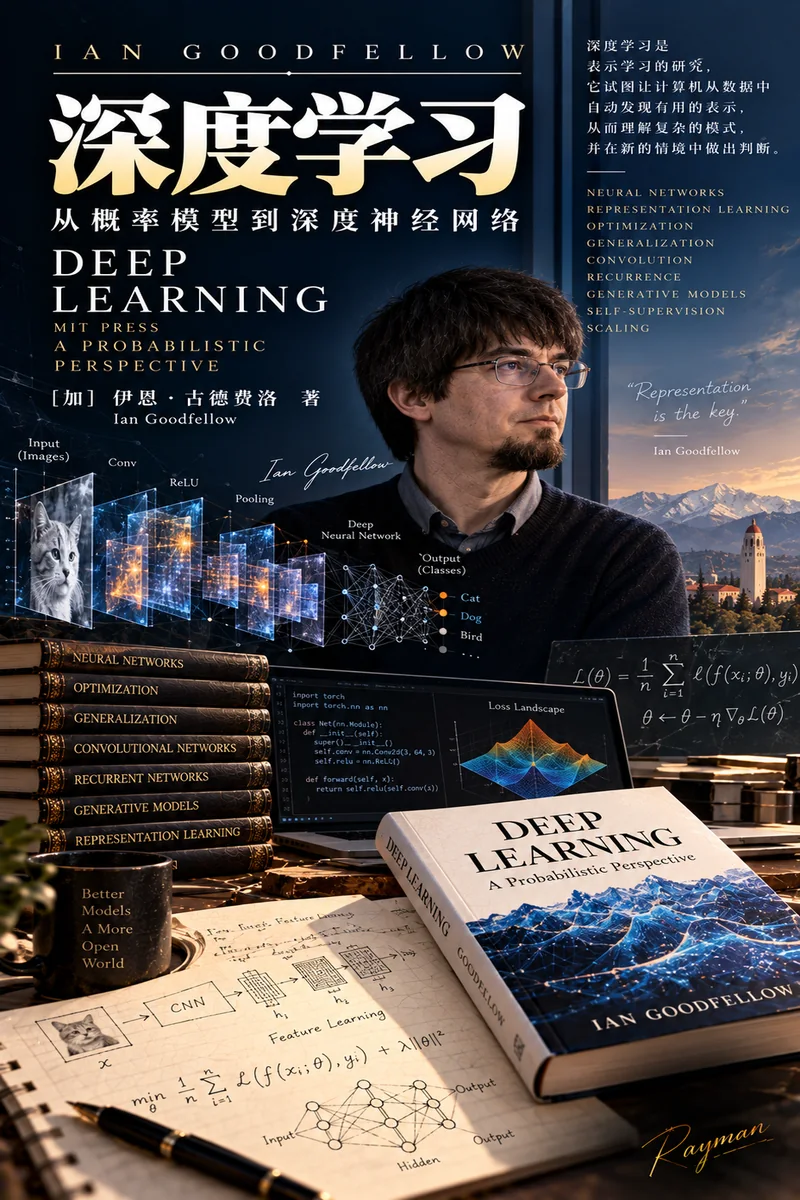
Deep Learning
《深度学习》
- Published
- 2016
- Category
- Artificial Intelligence
- Difficulty
- Advanced
- Reading time
- ~45 hours
- Original language
- en
The Classic Index is not an objective scientific measure. It is this site's personal curation score.
What is this book about?
A textbook by three founders of deep learning that begins with linear algebra, probability, and numerical computation and builds up to convolutional networks, recurrent networks, regularization, and generative models. It does not aim for breadth; it insists on one principle: understand the mathematical structure first, then understand why some structures work in practice.
Why read it?
When deep learning is reduced to hyperparameter tuning and compute, this book reminds you what the technology actually rests on: differentiable representations, gradient flow, and the limits of statistical estimation. Its value is showing you where a model's assumptions lie — and therefore where it will fail.
Core Ideas
- The core of deep learning is transforming inputs layer by layer into more abstract, more separable representations rather than hand-engineering features.
- Backpropagation is merely an efficient implementation of the chain rule; the hard part is designing deep architectures that are easy to optimize.
- Generalization, not training error, is decided by the tension among regularization, data scale, and model capacity.
- Many practical tricks can be explained by a few mathematical principles: representation, optimization, and probability.
What questions does this book try to answer?
- Why can deep networks learn useful representations that shallow models cannot?
- Under what conditions does a model that excels on training data fail on new data?
Who should read it?
For readers already comfortable with linear algebra, calculus, and probability who want to understand deep learning rather than merely call its libraries.
Related Books
If you like this book