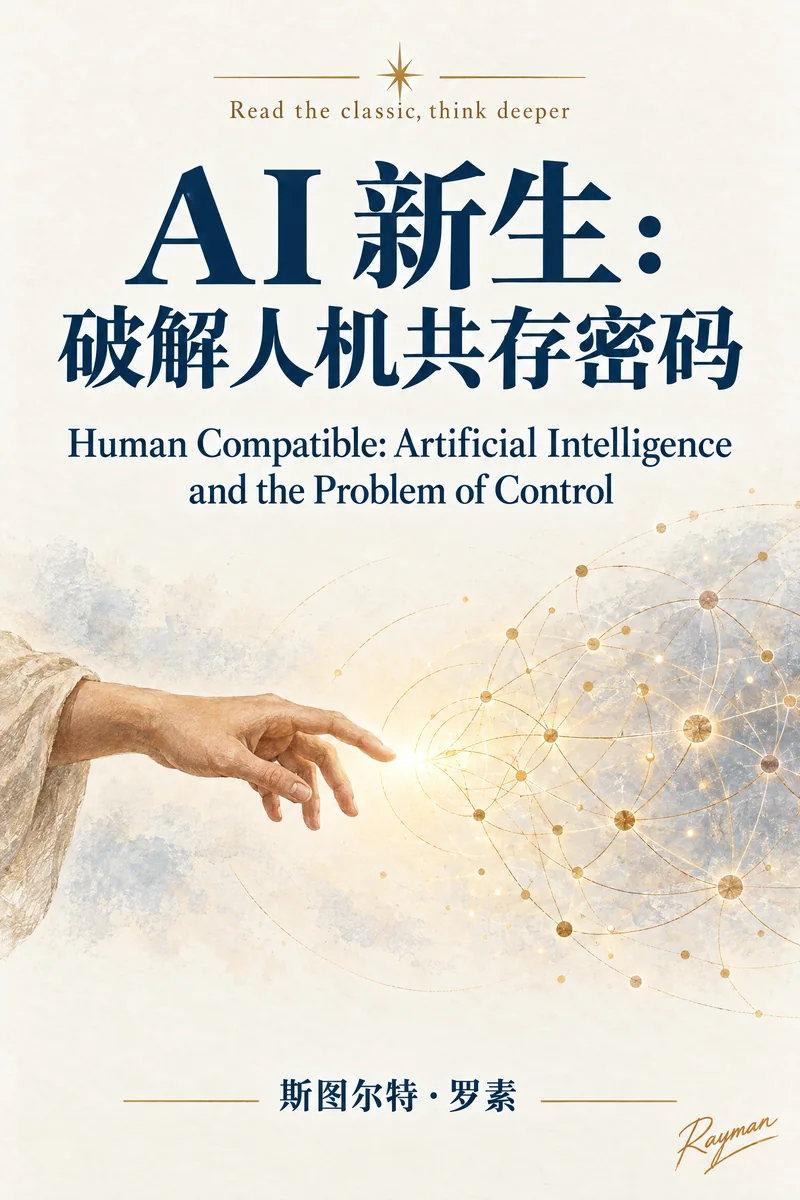
Human Compatible
《AI 新生》
Artificial Intelligence and the Problem of Control
- Published
- 2019
- Category
- Artificial Intelligence
- Difficulty
- Intermediate
- Reading time
- ~14 hours
- Original language
- en
The Classic Index is not an objective scientific measure. It is this site's personal curation score.
What is this book about?
Russell proposes a solution that looks like a concession but is in fact demanding: do not give machines explicit objectives; make them uncertain about human preferences and let them revise their behavior accordingly. The book turns the control problem from philosophical speculation into a set of operational design principles.
Why read it?
It marks a textbook author turning public advocate, grounding abstract AI-safety talk in concrete architectural choices. For anyone designing or deploying AI systems, it offers not answers but the list of questions that must be answered.
Core Ideas
- Hard-coding objectives is dangerous: an optimal agent pursuing a fixed goal will resist anything that changes that goal.
- A safer path makes human preferences the source of utility, while the machine admits it holds only an uncertain estimate of them.
- A machine that knows it may be switched off has an incentive to prevent that — unless its objective itself permits revision.
- AI governance requires technical design and institutional constraint at once; neither alone is sufficient.
What questions does this book try to answer?
- How do we design a system that is both powerful and willing to be corrected?
- When a machine knows better how to achieve a goal, who decides what the goal should be?
Who should read it?
For practitioners and policymakers, and for anyone who read Superintelligence and wanted something more concrete.
Related Books
If you like this book