Psychology & Cognitive Science 2011
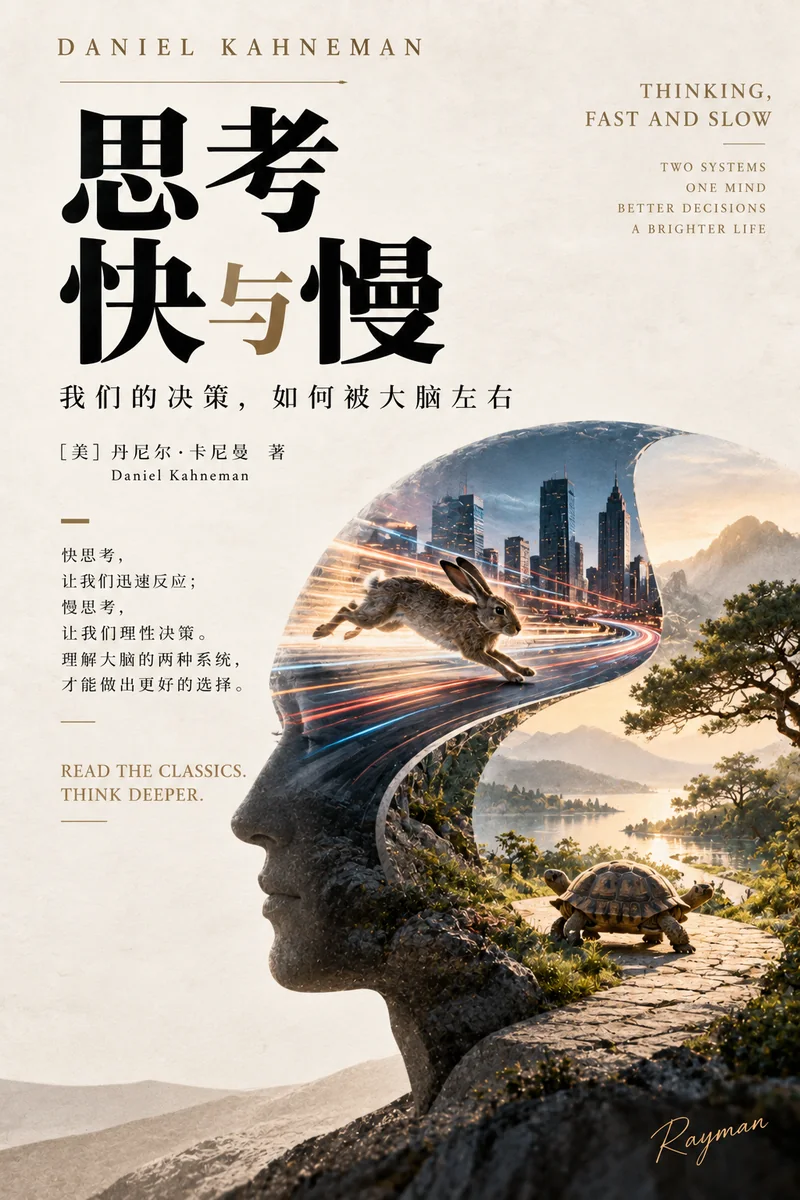
Thinking, Fast and Slow
《思考,快与慢》
- Published
- 2011
- Category
- Psychology & Cognitive Science
- Difficulty
- Intermediate
- Reading time
- ~20 hours
- Original language
- en
The Classic Index is not an objective scientific measure. It is this site's personal curation score.
What is this book about?
Kahneman organizes decades of judgment-and-decision research as a dialogue between two cognitive systems: fast, automatic System 1, and slow, effortful System 2. Through a long series of experiments he shows when and how people depart from rationality, and why those departures are so hard to notice from the inside.
Why read it?
It reframes the question of why people misjudge: error is not a sign of stupidity but the output of predictable cognitive machinery. For fields that require judgment under uncertainty — investing, management, clinical diagnosis — it supplies a shared vocabulary.
Core Ideas
- Intuitive judgment runs on heuristics that usually work but produce stable biases — anchoring, availability, representativeness — under identifiable conditions.
- Losses hurt more than equivalent gains please, and this asymmetry shapes risk-taking across domains.
- Confidence in one’s own judgment is often uncorrelated with its accuracy.
- The experiencing self and the remembering self evaluate the same episode differently: one weighs duration, the other fixates on peak and ending.
What questions does this book try to answer?
- Why do people misjudge systematically rather than merely occasionally?
- Within what range is intuition reliable, and within what range is statistical reasoning?
Who should read it?
For anyone who must judge under uncertainty, and for readers who want to see where behavioral economics came from; no statistics background is required, though the density of experiments demands patience.
Reading Notes
2026-09-26
Most of our errors are not random but systematic: fast thinking answers when it should have stayed quiet.
I read this book slowly, because nearly every chapter pointed at an error I had just made. Its effect was not to make me more rational — that expectation is naive — but to let me recognize, afterward, which trap I fell into. I now pause before important judgments and ask one question: is this a fast intuition, or a slow conclusion? That single pause has already been worth the whole book.
Related Books
If you like this book