Psychology & Cognitive Science 2021
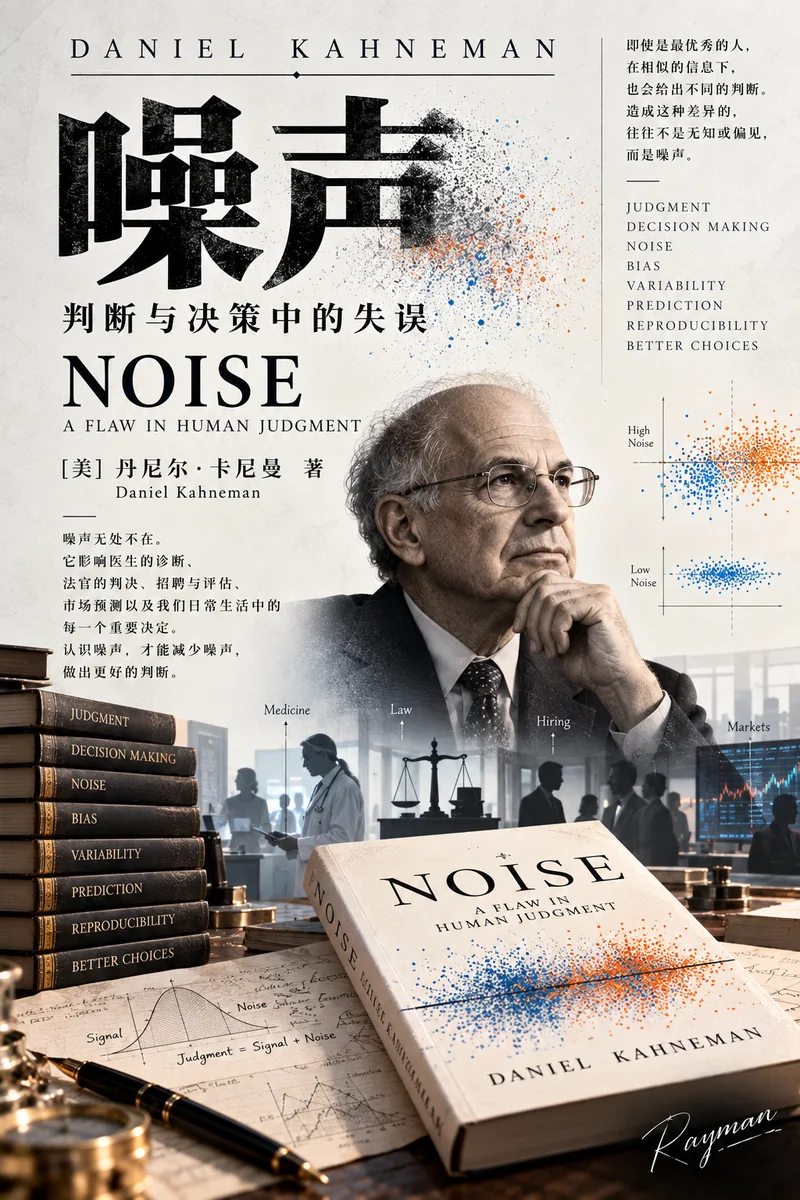
Noise
《噪声》
- Published
- 2021
- Category
- Psychology & Cognitive Science
- Difficulty
- Intermediate
- Reading time
- ~16 hours
- Original language
- en
The Classic Index is not an objective scientific measure. It is this site's personal curation score.
What is this book about?
The three authors separate two kinds of error in judgment: bias, a systematic tilt shared across cases, and noise, the inconsistency that arises when the same problem gets different answers from different judges or on different days. Evidence from insurance, courts, medicine, and hiring shows that noise is routinely underestimated — and often easier to reduce than bias.
Why read it?
It fills the gap left by Thinking, Fast and Slow: that book covered systematic bias, this one covers random inconsistency. For any organization that relies on expert judgment, the resulting principles of "decision hygiene" are directly actionable.
Core Ideas
- Noise and bias are independent sources of error: the average judgment can be right while individual judgments scatter widely.
- Noise splits into level noise (different people hold different baselines), pattern noise (a person responds differently across cases), and occasion noise (the same person answers differently at different times).
- Simple rules, structured scales, and independent multiple ratings often cut noise substantially without sacrificing accuracy.
- Reducing noise calls less for better judges than for better judging procedures.
What questions does this book try to answer?
- Why does the same professional judgment come out differently at another time or from another person?
- How can an organization reduce inconsistency while keeping expert judgment intact?
Who should read it?
For managers, clinicians, judges, recruiters, and risk officers, and for anyone concerned with decision quality; some familiarity with basic statistics and bias concepts helps.
Related Books
If you like this book